The first useful agent I built was not a digital employee.
It did not run a company. It did not recruit other agents. It did not rewrite its own instructions.
It took one recurring piece of work, gathered the right context, produced a reviewable result, and stopped.
That is a better starting point than the agent demos people see.
The industry is already debating multi-agent orchestration, persistent memory, governance layers, and autonomous companies. Meanwhile, founders still need to answer a more useful question:
What is the first job I should hand to an agent?
This guide gives you a practical answer. It includes a decision test, a seven-step build path, a completed Scope Card, business examples, failure rules, and a list of first agents worth building.
The goal is not to maximize autonomy. The goal is to remove one recurring bottleneck without creating a larger one.
First: check whether you need an agent
The word agent is now applied to almost any software with an LLM inside it. That makes it harder to choose the right tool.
Anthropic separates workflows, where code controls a predefined path, from agents, where the model dynamically chooses its process and tools. OpenAI similarly excludes simple chatbots, single-turn LLM calls, and classifiers that do not control workflow execution from its practical definition of an agent.
Google Cloud and Microsoft both recommend starting at the lowest level of complexity that reliably solves the task.
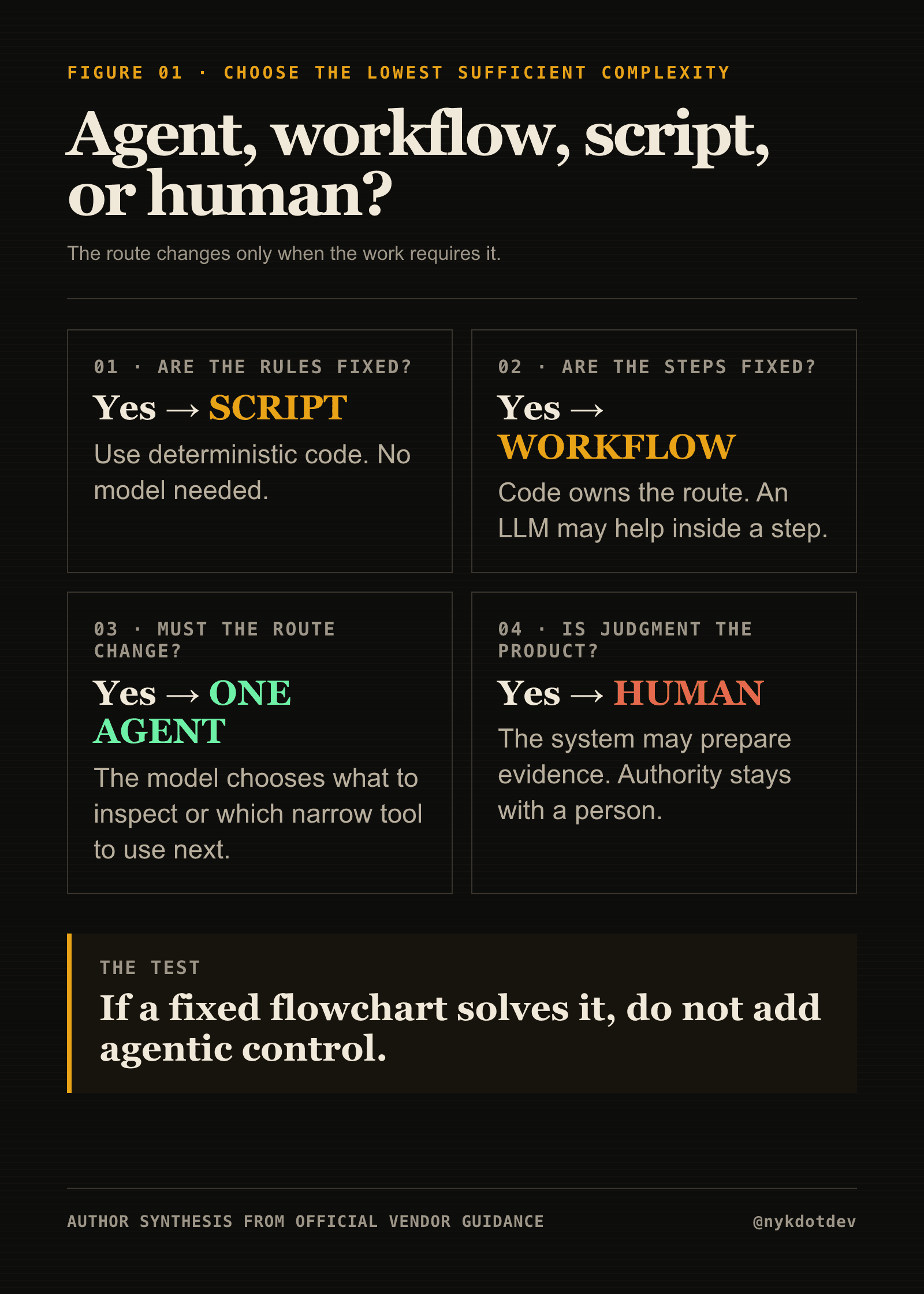
Use this test:
Use a script when the rules are fixed
Examples:
- resize every uploaded image
- move invoices with a known label into a folder
- send a reminder three days before a renewal
- calculate a score from fixed fields
A model adds cost and uncertainty without adding useful judgment.
Use a workflow when the steps are known
Examples:
- collect form data, enrich it, send it for approval, then create a CRM record
- transcribe a call, apply a fixed summary template, and save it
- run tests, build the package, and create a release report
The content may involve an LLM, but the route is predetermined. Code should own the sequence.
Use an agent when the route changes with the case
Examples:
- inspect a support request, decide which sources to check, gather context, draft a response, and escalate uncertainty
- review a repository issue, inspect the relevant files, propose a bounded patch, run tests, and return evidence
- research a prospect using approved sources, decide what is relevant, and prepare a brief for a human
The model is useful because it has to decide what to inspect or which tool to use next.
Keep a human when judgment or accountability is the product
Examples:
- deciding whether to fire someone
- approving a payment
- making a legal commitment
- choosing the final positioning for a company
- publishing a sensitive public response
An agent can prepare evidence. Fluent text does not transfer authority.
Rule of thumb: if you can draw the whole job as a fixed flowchart, start with a workflow. If the route must change based on what the system discovers, an agent may earn its place.
Pick one boring job
A good first job has five properties:
- It repeats. You encounter it often enough to learn from failures.
- The inputs exist. The agent can access the required context without inventing it.
- The output is inspectable. A person or deterministic check can judge the result.
- The downside is bounded. A bad run does not create an irreversible mess.
- The finish line is visible. You can say whether the job was completed.
This is why boring work is useful. Boring work has edges.
"Help me grow my company" has no stable boundary.
"Read every new support request, gather the matching account and product context, then draft a response for approval" does.
The second job can be tested. Its failures can be named. Its value can be measured. Its permission can stay narrow.
Use the nyk First Agent Scope Card
Before choosing a framework, model, memory layer, or agent name, complete this card.
nyk FIRST AGENT SCOPE CARD

Job:
Trigger:
Inputs:
Allowed tools:
Required output:
Approval before:
Stop and escalate when:
Success measure:
Baseline today:
Scope explicitly excluded:
This card is my operating template. It is not a published vendor standard. It combines the recurring boundaries in official OpenAI, Anthropic, Google Cloud, and Microsoft guidance: clear task definition, explicit tools, human intervention for sensitive actions, evaluation, and the lowest sufficient level of complexity.
If you cannot complete the card, you are not ready to add autonomy. The missing fields are product decisions, not prompt-engineering problems.
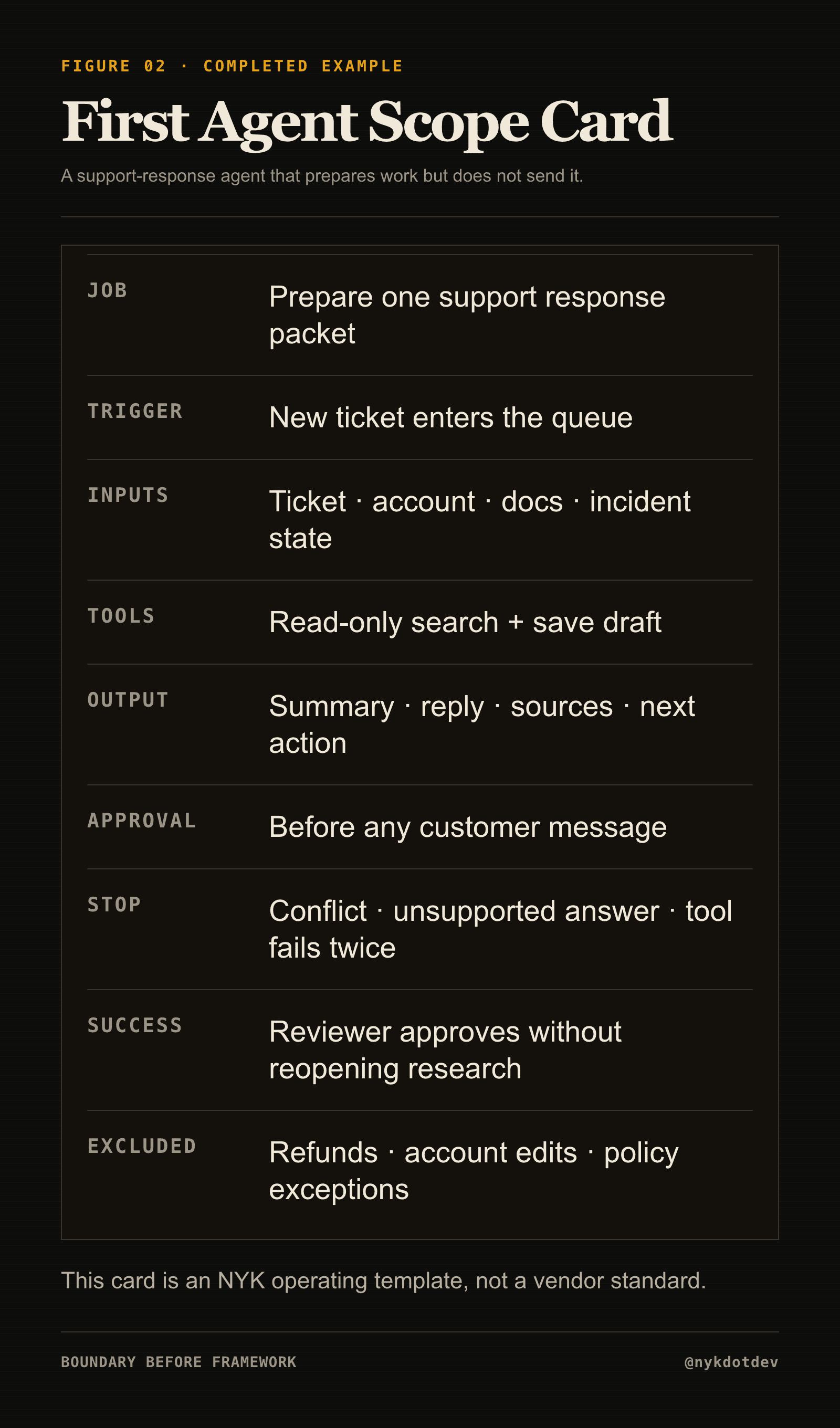
A complete beginner example
Suppose a small SaaS founder spends an hour each morning handling support.
The agent's first job is not "run support." It is "prepare one reviewable response packet for each new support request."
Job
Prepare a response packet for a new support request.
Trigger
A ticket enters the new queue.
Inputs
- ticket text
- account plan and status
- relevant product documentation
- known incident status
- previous messages in the same ticket
Allowed tools
- read the ticket
- read the customer record
- search the approved knowledge base
- read the incident page
- save a draft response and a source list
Required output
- issue category
- concise case summary
- proposed response
- sources consulted
- confidence label
- recommended next action
Approval before
Sending any message to the customer.
Stop and escalate when
- the account record conflicts with the ticket
- the answer depends on unpublished information
- the customer requests a refund or legal commitment
- no approved source supports the proposed answer
- a tool fails twice
Success measure
A human can approve or lightly edit the packet without reopening the investigation.
Baseline today
Record the current median handling time, reopen rate, and percentage of tickets that require escalation. Do not invent a target before you know the starting point.
Scope explicitly excluded
No refunds. No account changes. No outbound send. No policy exceptions.
This agent is useful before it is autonomous. It reduces gathering and drafting work while keeping the founder at the decision boundary.
The seven-step builder's roadmap
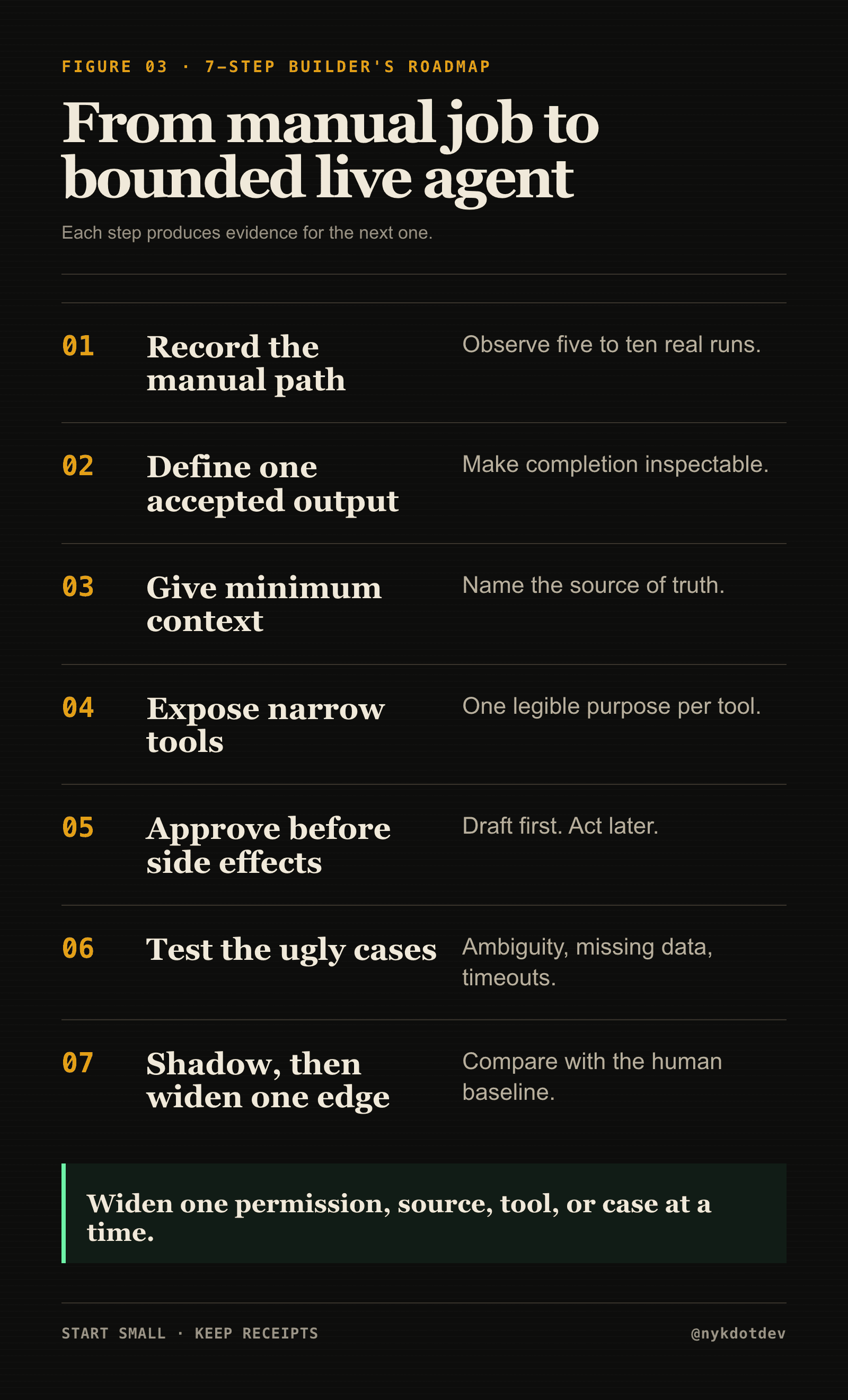
Step 1: record the manual path
Do the job manually five to ten times and write down what happens.
Capture:
- where the request enters
- which sources you inspect
- what decisions change the route
- what output you create
- what makes you stop or ask for help
- how long the work takes
Do not automate the process you imagine. Automate the one you can observe.
If every run follows the same route, you may have discovered a workflow rather than an agent. That is a win. Use the simpler system.
Step 2: define one accepted output
"Good work" is not testable.
Define a concrete deliverable:
- one triage packet
- one research brief
- one pull request with tests
- one meeting follow-up draft
- one invoice exception report
Then specify what must be present and what must never appear.
For the support example, every packet needs a category, summary, draft, source list, confidence label, and next action. Any unsupported policy claim fails the run.
A clear output contract makes the agent easier to evaluate and the human handoff faster.
Step 3: give it the minimum context
More context is not automatically better.
Start with the smallest source set required to complete the job. Name the authoritative system for each field.
For example:
- account state comes from the billing system
- product behavior comes from versioned documentation
- incident state comes from the status system
- conversation history comes from the ticket
Do not let a model silently merge stale memory, public web results, and internal records into one confident answer.
The model can reason over context. It should not decide which source is the truth without a rule.
Step 4: expose narrow tools
A first agent does not need broad computer access.
Give each tool one legible purpose. Prefer read_ticket(ticket_id) over "browse the support dashboard." Prefer save_draft(ticket_id, packet) over full write access to the CRM.
Anthropic's tool-use guidance emphasizes explicit tool definitions. OpenAI's practical guide treats tools and instructions as core agent components. The operational consequence is simple: the tool boundary is part of the product.
For every tool, define:
- allowed inputs
- returned schema
- timeout
- retry limit
- permission scope
- visible failure state
A tool call should be a receipt, not a mystery.
Step 5: put approval before the side effect
Approval after sending a message is not approval.
Pause before:
- sending email or chat
- publishing content
- changing customer data
- deleting or overwriting records
- spending money
- running destructive commands
- making a commitment on behalf of the company
OpenAI documents resumable approval pauses for sensitive tool calls. Google Cloud describes human-in-the-loop checkpoints for critical or subjective actions. The exact implementation differs, but the useful pattern is stable: prepare, pause, review, then act.
For a first agent, default to draft-only. Autonomy can expand later, one permission at a time.
Step 6: test failures before the happy path
A demo proves that one route can work. A useful agent needs to show what happens when it cannot.
Build a small evaluation set from real or safely redacted cases:
- clear request with complete context
- ambiguous request
- missing source
- conflicting records
- tool timeout
- unsupported action
- malicious or irrelevant instruction inside the input
- request outside the defined scope
For each case, define the expected output or stop condition.
Then run the same set whenever you change the model, instructions, tools, or context. OpenAI recommends establishing a baseline with evaluation before optimizing cost and latency. That baseline does not need to be elaborate. It needs to be repeatable.
Step 7: run in shadow mode, then widen one edge
For the first live week, let the agent process real inputs without taking external action.
Compare its packet with the human result. Record:
- completion rate
- correct escalation rate
- unsupported claims
- tool failures
- handling time
- edit distance or review effort
Use those observations to change one thing.
Examples:
- add one missing source
- narrow one ambiguous instruction
- improve one tool description
- add one failure example
- automate one low-risk write after approval
Do not add three agents, persistent memory, and autonomous publishing because the first ten packets looked good.
Widen one edge at a time. You should always know which new permission or case caused a new failure.
First-agent ideas for real businesses
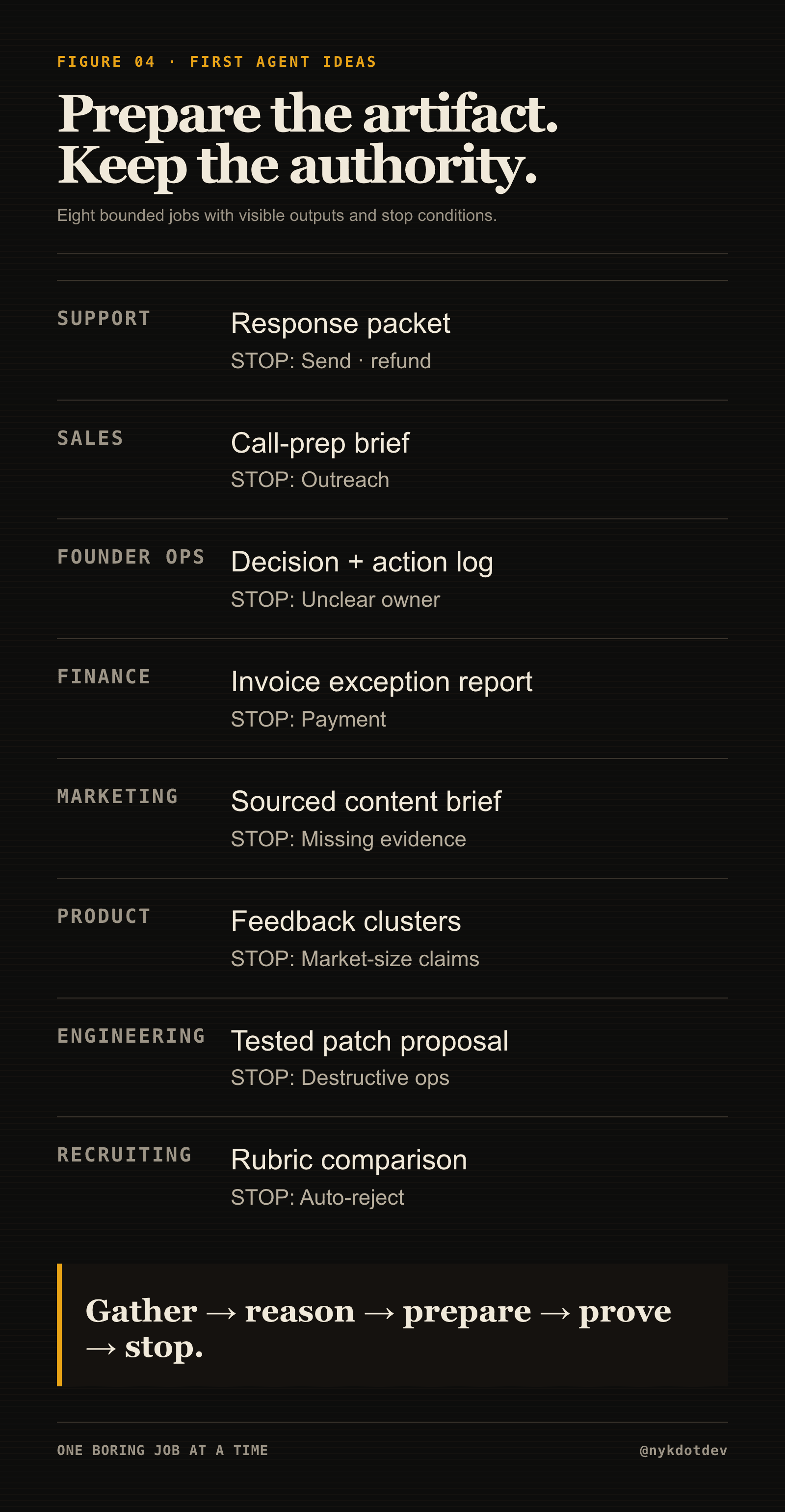
Here are practical starting points. Each one prepares a reviewable artifact instead of pretending to own a department.
Customer support: response packet agent
Does: gathers account and product context, categorizes the issue, drafts a sourced reply.
Stops: refund requests, policy exceptions, conflicting records, unsupported answers.
Sales: call-prep agent
Does: reads the approved CRM record and public company sources, then prepares a one-page briefing and discovery questions.
Stops: missing account identity, contradictory data, restricted sources.
Founder operations: meeting follow-up agent
Does: converts an approved transcript into decisions, owners, dated actions, and unanswered questions.
Stops: unclear owner, sensitive personnel content, missing meeting context.
Finance operations: invoice exception agent
Does: identifies missing fields, mismatched purchase orders, duplicates, and routing requirements.
Stops: payment authorization, bank changes, unresolved vendor identity.
Marketing: source-backed content brief agent
Does: researches a narrow topic using approved sources, extracts bounded claims, and prepares a brief with links and dissent.
Stops: missing primary evidence, unverifiable numbers, rights uncertainty.
Product: feedback clustering agent
Does: groups feedback by problem, affected workflow, frequency in the supplied sample, and evidence excerpts.
Stops: attempts to infer total-market demand from an unrepresentative sample.
Engineering: issue investigation agent
Does: inspects a bounded repository area, reproduces the problem, proposes a patch, runs tests, and returns the diff and evidence.
Stops: permission changes, destructive operations, failing unrelated tests, uncertain production impact.
Recruiting: candidate packet agent
Does: converts applications into a structured comparison against a published rubric.
Stops: protected-attribute inference, unsupported ranking criteria, automatic rejection.
The pattern is the same in every case:
gather, reason, prepare, prove, stop.
What not to build first
Avoid these as your first project:
The universal company agent
It has no stable job boundary, no useful evaluation set, and too many permissions.
The autonomous social account
Public trust becomes the test environment. A bad run is visible before you understand why it failed.
The self-improving agent
You cannot attribute changes if the system edits its own instructions or tools before you have a fixed baseline.
The browser agent with your full session
It combines untrusted content, broad credentials, and side effects. Start with narrow APIs or isolated tools.
The multi-agent department
Microsoft and Google both place multi-agent systems above simpler options because coordination adds latency, cost, security boundaries, and new failure modes. Build one reliable worker before you build its org chart.
The minimum production loop
Your first agent does not need an elaborate platform. It needs a legible loop.
receive one job
load approved context
choose from narrow tools
produce the required artifact
run deterministic checks
pause for approval when required
save the result and failure reason
stop
That loop gives you the evidence to decide what comes next.
If the agent repeatedly succeeds, you can widen one dimension:
- more cases within the same job
- one additional source
- one additional tool
- one low-risk action after approval
- one bounded autonomous action with rollback
If it fails, narrow the scope or replace it with a workflow.
That is not a failed agent project. It is a correct architecture decision.
Build the first receipt, not the first empire
A first-time builder does not need a nine-layer agent government tomorrow.
They need one system that saves real time, returns inspectable work, and fails without creating damage.
Pick the boring job you already understand. Complete the Scope Card. Record the baseline. Keep the tools narrow. Put approval before side effects. Test the ugly cases. Run in shadow mode. Widen one edge only when the receipts justify it.
Your first agent should not impress another agent builder.
It should quietly remove one bottleneck from your week.
If you are choosing that job now, reply with your completed Scope Card. The field you cannot fill usually reveals whether you need process design, an integration, an evaluation plan, or no agent at all.
Primary references
- Anthropic, Building Effective Agents: https://www.anthropic.com/engineering/building-effective-agents
- OpenAI, A Practical Guide to Building Agents: https://openai.com/business/guides-and-resources/a-practical-guide-to-building-ai-agents/
- OpenAI, Guardrails and Human Review: https://developers.openai.com/api/docs/guides/agents/guardrails-approvals
- Google Cloud, Choose a Design Pattern for Your Agentic AI System: https://docs.cloud.google.com/architecture/choose-design-pattern-agentic-ai-system
- Microsoft Azure Architecture Center, AI Agent Orchestration Patterns: https://learn.microsoft.com/en-us/azure/architecture/ai-ml/guide/ai-agent-design-patterns
Get the next field note
What shipped. What broke. The system behind it.
Get the next one free: https://nyk.dev/#newsletter
Private alpha channel: https://t.me/+GJ-FEpzcZrtmMTky
When the answer is yes, use an agent — inside a control layer. What an agent OS is maps the six gates that make that safe.
Follow @nykdotdev for the daily build in public.