Also published as an X article: https://x.com/nykdotdev/status/2078750157353656720.
Most ambitious people do not fail from laziness.
The usual failure is a flat system.
One inbox for money, health, kids, the main company, the side product, the half-built idea, and the random DMs that feel like opportunity. All of it competes on the same list. Nothing has a seat. So the loudest thing wins, the important thing waits, and "being productive" becomes a full-time job of reorganizing tools.
All of it competes on the same list.
This piece is not another app recommendation.
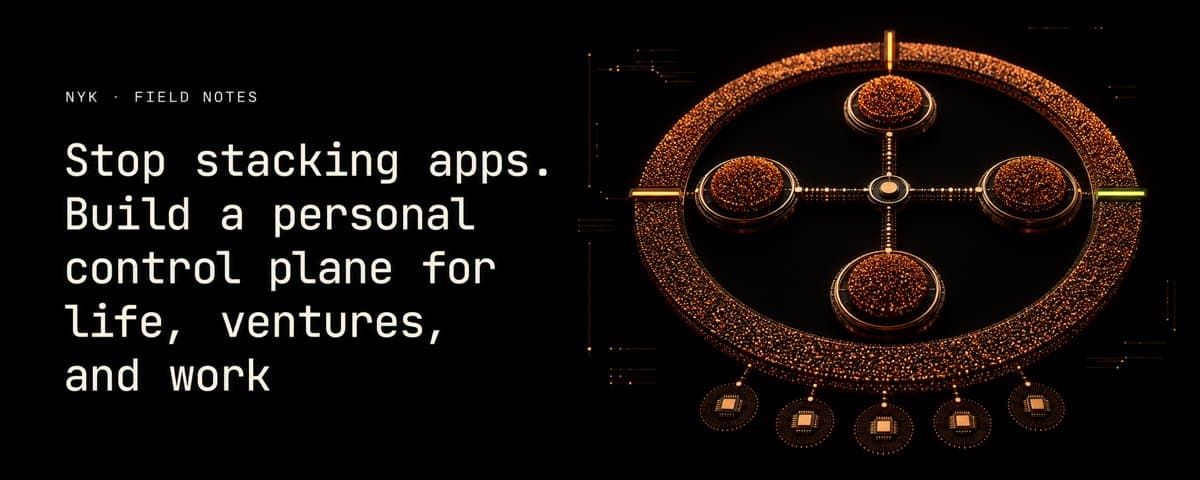
It is a design for a personal control plane: a small set of seats, loops, and gates that routes attention across life, ventures, and deep work without turning maintenance into a second career.
By the end:
- A four-seat map that stops flattening your life
- Five loops that run the week
- A routing table and three gates before irreversible work
- The Personal Control Plane Install Checklist (copy-paste)
Use the checklist as-is. Change the tools. Do not skip the seats.
Why the default approach fails
The default stack looks sophisticated:
The default stack looks sophisticated:
- a task app
- a notes app called a second brain
- a calendar that is already full
- a goal doc nobody opened since January
Each piece is fine in isolation.
Together they fail for multi-surface people for three structural reasons.
1. Storage is not operations. Second brains and PARA-style folders excel at capture and retrieval. They do not decide what ships this week. Knowing where the note lives is not the same as knowing which venture gets the deep work block on Tuesday.
2. One queue cannot hold many identities. When "fix production bug," "renew passport," and "decide if venture B still earns rent" share a single priority field, the UI lies. Those items are not the same class of work. Treating them as peers is how founders look busy while the active build starves.
3. The system becomes the project. High-maintenance setups collapse within weeks. Color codes, nested dashboards, perfect weekly templates: if the system needs more energy than it returns, it is not a system. It is a hobby with better branding.
The fix is not discipline theater.
The fix is a seating chart and a few hard rules.
The four seats of a personal control plane
Borrow the language operators already use for software: a control plane decides where work is allowed to run. Your personal version does the same for attention.
Borrow the language operators already use for software: a control plane decides where work is allowed to run. Your personal version does the same for attent
Define four seats. Everything you care about must claim one.
| Seat | Question it answers | Examples | Typical failure if ignored |
|---|---|---|---|
| Life | What must stay true for the rest to matter | health, family, finances, rest, legal basics | burnout, silent debt, relationship debt |
| Ventures | What entities am I building or operating | company, product, studio, brand node, research bet | zombie projects, fake parallel progress |
| Work | What deep craft earns the next receipt | shipping, sales calls, design, writing, infra | calendar full of meetings, zero shipped surface |
| Self | What renews judgment | learning, training, solitude, therapy, craft practice | empty hustle, stale taste, brittle decisions |
Rules for seats:
- Every item gets one primary seat. Cross-links are fine. Dual ownership is not.
- Ventures are entities, not tasks. "Ship feature X" lives under Work, owned by Venture A. "Kill or keep Venture B" lives under Ventures.
- Life is not the leftover. If Life only gets scraps after Work is exhausted, the control plane is inverted.
- Self is infrastructure. Sleep, strength, and quiet thinking are not rewards. They are capacity for the other three seats.
Equal time budgets are not required.
What is required: four named claims so nothing important only exists as a vague guilt feeling.
A pattern that shows up when people run several products under one personal brand is simple: the person is the distribution layer, each venture is a node with its own seat budget, and Work is the craft that feeds whichever node is active. The brand is not a fifth company. It is the graph that holds the nodes. Steal the pattern. Ignore anyone's private tooling.
The five loops that run the week
Seats without loops are posters.
These five loops are enough. Invent a sixth only if one of the five dies first.
1) Capture (minutes, not perfection)
Anything that enters your head gets out of your head within the day:
- open loops
- ideas
- commitments you made out loud
- risks you noticed
One inbox is enough: notes app, paper, voice dump. Capture is not organization. It is trust that the loop will not rely on memory.
Anti-pattern: twenty capture surfaces (email, chat, sticky notes, three apps, browser tabs). Pick one primary. Drain the others weekly.
2) Route (seat assignment)
At least once a day, or in a short evening pass, assign each open item a seat:
- Life / Ventures / Work / Self
- or Trash / Someday if it does not earn a seat
Routing is the step most systems skip. Skipping it is why the inbox feels heavy forever.
3) Commit (the weekly contract)
Once a week, choose a small set of commitments, not a fantasy backlog:
- 1 Life non-negotiable
- 1 Venture decision or milestone (or "hold")
- 1 to 3 Work ships (things that produce a receipt)
- 1 Self practice
A commitment is binary enough to review. "Make progress on the product" is not. "Ship the install path for X" is.
Hard rule many multi-venture people need: one active build venture at a time for deep Work hours. Other ventures can be maintain, measure, or harvest. They do not all get invention bandwidth. Parallel horses look productive until none of them finish.
4) Ship (daily execution with a receipt)
Deep work blocks exist to produce receipts:
- PR merged
- page live
- email sent to a real buyer
- design approved
- article drafted
- invoice paid
Days that only produce motion (meetings, polish, research without an output), the loop did not close. Motion can be necessary. It is not a ship.
Protect at least one ship block on most workdays. Put it where your energy is real, not where your calendar is empty by accident.
5) Review (the real operating system)
Weekly review is not journaling cosplay. It is a short board meeting with yourself.
Ask:
- What shipped (receipts)
- What slipped (and which seat owned it)
- What should die
- What should stay on hold
- What gets next week's commit slots
Monthly, add one harder question per venture: does this still earn rent (money, learning, distribution, or joy at a level that justifies the seat)? Fail that test and demote or kill. Zombie ventures are attention leaks with logos.
Mechanism: the routing table and three gates
Here is the part most productivity writing never makes concrete.
Your control plane needs a routing table: a written rule for where different classes of input go.
Copy and edit this:
PERSONAL ROUTING TABLE (edit once, then only when seats change)

Input class → Seat → Default action

Health / sleep / family → Life → calendar first, tasks second
Taxes / legal / money → Life → deadline system, not vibes
Product A feature work → Work → owned by Venture A
Product B bugs only → Work → maintain mode (no new scope)
Brand / public writing → Work → distribution for active node
New idea / shiny object → Ventures → 48h hold, then seat or trash
Inbound collab / deal → Ventures → score vs active build
Learning / course FOMO → Self → only if supports active seat
Social feed impulse → Trash → do not route to Work
Gates sit in front of irreversible or expensive moves:
| Gate | When | Pass condition |
|---|---|---|
| Scope gate | Before starting a multi-day effort | One sentence problem, one seat owner, one definition of done |
| Switch gate | Before jumping ventures mid-day | Written reason; active-build rule still holds |
| Kill gate | Before adding a new venture or major project | What dies or pauses to pay for it |
When nothing has to die for the new thing to live, capacity is being lied about.
That is the whole mechanism. Seats classify. Loops move. Gates protect. Tools are interchangeable.
Worked example: a composite operator week
Imagine someone running:
- a primary product (active build)
- a small studio or service line (maintain)
- a personal brand that distributes both
- a normal human life
Sunday (40 minutes) Review last week's receipts. Kill two zombie tasks. Set next week's commits: Life (gym 3x + one family block), Ventures (decide whether service line stays maintain), Work (ship one installable surface + two customer conversations), Self (two deep reading blocks). Update routing table if a new input class appeared.
Monday through Thursday Mornings: Work ship blocks for the active build only. Afternoons: maintain the service line with a timebox, not open-ended "growth." Brand work is scheduled, not infinite scrolling for inspiration. The capture habit runs all day into one inbox. Evening route pass: 10 minutes.
Friday Ship or explicitly slip. Silent slip is not allowed. Review gate for any new idea that tried to become a project mid-week. Most ideas go to Someday or Trash. That is success, not failure.
Saturday Life and Self get real weight. Work that steals Saturday by default means the seating chart is fake.
Notice what is missing: a 40-page Notion OS, twelve dashboards, and a productivity identity built on tools. The week runs on commits and receipts.
Caps before checklists
Without hard caps, any checklist becomes theater.
| Cap | Default |
|---|---|
| Active build ventures | 1 |
| Concurrent deep Work items (WIP) | 1 to 3 |
| Primary tools | 5 or fewer (capture, tasks, calendar, notes, comms) |
| System-tax (configuring the system) | under 60 min/week, ideally 5 to 10% of deep-work hours |
| Inbox age | nothing unprocessed older than 7 days |
| Bad-week mode | still runs in 15 minutes or less |
Vanity metrics to ignore as primaries: notes created, streak days, plugin counts, dashboard beauty, AI token volume.
Receipts to prefer: external ships, MIT hit rate, review adherence, kills logged, active project count under cap, system-tax minutes.
Personal Control Plane Install Checklist
Use this when: you feel busy, multi-threaded, and still unclear what "done" means this week.
PERSONAL CONTROL PLANE: INSTALL CHECKLIST

DAY-0 (2 hours max, no archive migration)
[ ] Name four seats: Life / Ventures / Work / Self
[ ] List every open project under one primary seat (no dual owners)
[ ] Mark exactly one venture ACTIVE BUILD (others: maintain / harvest / kill-candidate)
[ ] Choose ONE capture inbox + calendar of record
[ ] Write WIP cap number (deep Work concurrent items)
[ ] Write three gates: Scope / Switch / Kill
[ ] Schedule recurring weekly review
[ ] Set tool freeze end date (+30 to 90 days)
[ ] Pick tools last (calendar + tasks + notes is enough)

DAILY (10 to 15 min; bad week: 15 min total)
[ ] Capture open loops into the one inbox (no taxonomy at capture)
[ ] Route new items to a seat or trash
[ ] Set one MIT for the active build (or Life non-negotiable on Life days)
[ ] Protect one ship block on workdays
[ ] End day: MIT done Y/N + name tomorrow's first ship

WEEKLY (30 to 45 min)
[ ] Get clear: empty capture + head dump
[ ] List receipts (external ships) and slips with seat owners
[ ] Enforce WIP cap (start nothing without finish/park)
[ ] Kill or demote at least one candidate (if nothing dies, look harder)
[ ] Set next week commits:
 - Life: 1 non-negotiable
 - Ventures: 1 decision or milestone (or explicit hold)
 - Work: 1 to 3 ships with receipts
 - Self: 1 practice
[ ] Block ship time on the calendar for Work commits
[ ] Log scorecard: ships, MIT hit rate, review done Y/N, active projects, system-tax min
[ ] Confirm active-build rule still true

MONTHLY (45 to 60 min)
[ ] Per venture: still earns rent? (money / learning / distribution / real energy)
[ ] Kill/park review with kills logged
[ ] Scorecard trend (not vibes)
[ ] Maintenance audit: system >60 min/week to stay organized? simplify
[ ] One system change max (or zero)
[ ] Update routing table; delete unused tools

QUARTERLY (90 min)
[ ] Theme + at most 3 bets
[ ] Kill portfolio losers
[ ] Re-validate freeze or one stack change only
[ ] Drop unused scorecard metrics
Bad-week mode (15 minutes)
When the full loop will not run, do only this:
- Empty capture into the one inbox
- Pick three commitments max
- Park or cancel one project
- Protect one deep block
Consistency of a degraded loop beats a perfect checklist you abandon.
One-page constitution (fill once)
Personal os constitution
Purpose: (blank)
Active build: (blank)
Active project / WIP cap: (blank)
Daily: 1 MIT + capture + route
Weekly: clear / current / commits / log ships
Monthly: kills + scorecard
Quarterly: <=3 bets
Tools (frozen until - -):
 Capture: (blank) Tasks: (blank) Calendar: (blank) Notes: (blank)
Kill defaults: (blank)
Agent rule: human approves money / public / hard commitments
System-tax budget: (blank) min/week
Within two weeks, a working install usually shows:
- fewer "urgent" items that were only loud
- clearer language for saying no
- at least one real kill or demotion
- Work hours that produce receipts instead of only motion
Failure modes to watch for
Seat theater Beautiful labels, same chaotic behavior. Tag every calendar block and task with a seat for two weeks until the habit sticks.
Infinite capture, zero route Inbox becomes a museum. Route daily, or the inbox is only a place to hide guilt.
Many active builds Every thread claims "priority." Enforce one active build. The Switch gate is not optional.
System as identity The OS gets optimized while nothing ships. Cap maintenance at 60 minutes per week. Need more? Delete features from the system.
Life as residual Work expands to fill all space. Put Life non-negotiables on the calendar first.
Review without kills A review that never ends a project is a diary. Force one kill or demotion candidate each month.
Tool cosplay Migrating apps to feel progress. Freeze tools for 30 days after the install checklist.
Adoption: when to skip, 30 days, and measurement
Skip the full control plane if:
- you have one job, one project, and low ambiguity (a simple list is enough)
- you are in acute crisis (stabilize Life first; do not redesign the OS mid-fire)
- you want a template to admire, not a weekly contract to keep
Also skip if you will not kill anything. A control plane without subtraction is a prettier overload.
Setting this up over 30 days
Earn each layer only after the previous one works on a bad week (Gall's Law: complex systems that work evolve from simple systems that worked).
Week 1: seats + baseline Four seats, one active build, one capture, calendar of record, MIT rule. Skip new apps. Do not migrate archives.
Week 2: clear loop + weekly review Daily capture + route. One real weekly review with commits and scorecard log. Inbox not a graveyard.
Week 3: caps and gates WIP cap enforced. Scope / Switch / Kill in writing. Practice "not this week" with a seat reason.
Week 4: rent, freeze, optional express Monthly venture rent check. Kill or demote one zombie. Cap system-tax. Freeze tools 30 to 90 days. Only if stable: one note becomes a ship, or one low-risk automation with a disable plan.
By day 30 you want a boring system that works on a bad Tuesday, not a showcase system that works only after a perfect Sunday setup.
Measuring whether it still earns rent
Keep a scorecard of seven metrics or fewer. A dashboard is not required.
| Metric | Cadence | Definition |
|---|---|---|
| Ship count | Weekly | External outcomes completed |
| MIT hit rate | Weekly % | Days primary MIT completed |
| Review adherence | Weekly / monthly | Review done Y/N; kill review Y/N |
| Active project count | Weekly | Must stay under WIP / portfolio cap |
| Active-build adherence | Weekly | Deep Work days stayed on primary venture |
| Kills | Monthly | Projects or bets explicitly stopped |
| System-tax minutes | Weekly | Time configuring the system vs operating through it |
Healthy pattern: ships stable or up, MIT rate real, adherence high, occasional kills, tax low.
Unhealthy pattern: perfect notes, rising tool count, zero kills, weeks of motion without receipts.
When the system is already failing (reform sequence)
- Stop building. Freeze tools for 6 weeks.
- Measure one week: ships, MIT hit, system-tax, active projects.
- Strip to spine: calendar + one inbox + MIT + weekly review.
- Set WIP cap and kill excess the same day.
- Restore weekly clear/current until trusted.
- Reintroduce structure only where retrieval fails.
- Add express obligation: notes feed a ship or a decision each week.
- Automate last, one workflow, measure minutes saved for 4 weeks.
- Monthly kill review stays on the calendar permanently.
- Reassess scorecard quarterly; drop unused metrics.
Fail the scorecard for two months, then simplify seats and loops before adding automation, agents, or another app. Automation multiplies whatever design you already have. It does not invent judgment.
Honest limits (as of 2026-07)
This is an attention architecture, not a personality transplant.
It will not:
- replace skill in your craft
- fix a venture with no market
- make multi-venture life free of tradeoffs
- excuse ignoring people who depend on you in the Life seat
It will:
- make tradeoffs visible
- stop flat inboxes from lying
- give you language for no
- put review and kills on a schedule
Tools will change. Model generations will change. The need for seats, loops, and gates will not.
A system that cannot kill work is not a system. It is a museum of intentions.
Next steps
run the Install Checklist once this week. Name four seats. Mark one active build. Set next week's commits with receipts.
Save this for the next time your calendar is full and your real work is still waiting.
Get the next field note
Get the next one free: https://nyk.dev/#newsletter
Free. Unsubscribe anytime.
Join the private NYK alpha channel for early notes and updates: https://t.me/+GJ-FEpzcZrtmMTky
Follow @nykdotdev for the daily build in public.
NYK field notes: Build agents that hold up.
Follow @nykdotdev for AI agent systems, Solana infrastructure, and build-in-public.
- Site: nyk.dev
- GitHub: 0xNyk
- RPC Edge: rpcedge.com